收稿日期: 2021-12-08
网络出版日期: 2022-03-11
基金资助
国家重点研发计划资助项目(2019YFB1600300)
Dynamic Reservation and Allocation Optimization Model of Shared Parking Slots in Multiple Parking Lots
Received date: 2021-12-08
Online published: 2022-03-11
Supported by
the National Key Research and Development Program of China(2019YFB1600300)
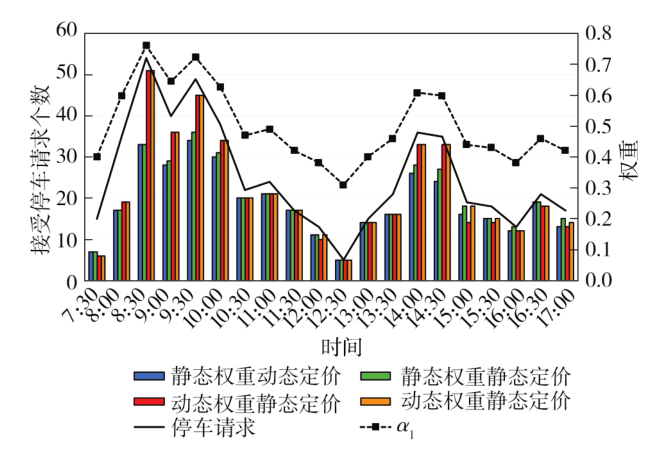
为了缓解停车矛盾,更加均衡地利用停车资源,实现对停车需求的动态响应,以多个相邻的路外停车场为研究对象,构建了多车场共享车位动态预约与分配的整数规划模型。模型以充分利用停车资源与节约用户停车成本为目标,采用线性加权将目标进行组合,根据实时的停车请求数量,自适应选取动态权重系数。通过对未到达的停车请求进行调整,迭代优化分配结果。引入动态定价机制均衡各车场的车位利用情况。采用车位利用率、停车请求接受率、平均步行距离和停车域均衡度4个指标对模型进行评价。设置仿真实验对模型进行验证。结果表明,相较于传统的不调整模型,提出的模型通过对未到达的停车请求进行迭代优化可使得利用率和接受率平均分别提升10.70%和20.08%,利用率的提升程度随着停车请求数量呈现先增大后减小的趋势,用户平均步行距离增大10 m左右,但仍满足用户出行需求。嵌入动态权重后的模型相较于静态权重模型利用率与接受率平均分别提升2.2%和10.88%,且动态权重模型能更好的适应停车需求的动态变化,使停车资源在高峰时段得到充分利用。相较于静态定价模型,引入动态定价机制使得车辆均匀的分配至各停车场,停车域均衡度平均降低0.074,实现停车资源的均衡利用。模型可为共享停车平台的停车分配与管理决策提供理论参考,缓解城市停车难问题。
王元庆, 蔺思玉, 谢明辉, 等 . 多停车场共享车位动态预约与分配优化模型[J]. 华南理工大学学报(自然科学版), 2022 , 50(9) : 12 -21 . DOI: 10.12141/j.issn.1000-565X.210780
In order to alleviate the parking difficulty, make more balanced use of parking resources and realize the dynamic response to parking demands, this study established an integer programming model for dynamic reservation and allocation of shared parking slots in multiple parking lots by taking several adjacent off-street parking lots as the research object. Aiming at making full use of parking resources and saving users’ parking costs, the model adopts linear weighting to combine the goals and adaptively selects dynamic weight coefficients according to the real-time number of parking requests. The allocation results were optimized iteratively by adjusting the parking requests from the car that does not arrive. In addition, dynamic pricing mechanism was introduced to balance the utilization of each parking lot. The model was evaluated by four indicators: parking space utilization rate, parking request acceptance rate, average walking distance and equilibrium degree of parking area. the model was verified by simulation experiments. The results show that, compared with the traditional unadjusted model, the proposed model can increase the utilization and acceptance rates by 10.70% and 20.08%, respectively, on average by iteratively optimizing the unreached parking requests. The improvement degree of utilization increases first and then decreases with the number of parking requests. The average walking distance of users increases by about 10m, but it still meets the travel needs of users. Compared with the static weight model, the utilization rate and acceptance rate of the embedded dynamic weight model are increased by 2.2% and 10.88%, respectively. The dynamic weight model can better adapt to the dynamic changes of parking demand, so that parking resources can be fully utilized during peak hours. Compared with the static pricing model, the dynamic pricing mechanism was introduced to evenly distribute vehicles to each parking lot, and the equilibrium degree of parking area is reduced by 0.074 on average, so as to realize the balanced utilization of parking resources. The model can provide theoretical reference for parking allocation and management decision-making of shared parking platform and alleviate the problem of urban parking.
| 1 | SHOUP D .Cruising for parking[J].Transport Policy,2006,13(6):479-486. |
| 2 | KONG Xiang-tian-rui, XU Su-xiu, CHENG Meng,et al .IoT-Enabled parking space sharing and allocation mechanisms[J].IEEE Transactions on Automation Science and Engineering,2018,15:1654-1664. |
| 3 | ABBOTT N T, BIGAZZI A Y .Utilizing shared parking to mitigate imbalanced supply in a dense urban neighborhood:case study in Vancouver,British Columbia,Canada[J].Transportation Research Record Journal of the Transportation Research Board,2017,2651:92-100. |
| 4 | YANG Hai, LIU Wei, WANG Xiao-lei,et al .On the morning commute problem with bottleneck congestion and parking space constraints[J].Transportation Research Part B:Methodological,2013(58):106-118. |
| 5 | SHAO Chao-yi, YANG Hai, ZHANG Yi,et al .A simple reservation and allocation model of shared parking lots[J].Transportation Research Part C:Emerging Technologies,2016,71:303-312. |
| 6 | 姚恩建,张正超,张嘉霖,等 .居住区共享泊位资源优化配置模型及算法[J].交通运输系统工程与信息,2017,17:160-167. |
| 6 | YAO En-jian, ZHANG Zheng-chao, ZHANG Jia-lin,et al .A model and algorithm for optimization of the utilization of residential shared parking slots[J].Journal of Transportation Systems Engineering and Information Technology,2017,17:160-167. |
| 7 | 孙会君,傅丹华,吕莹,等 .基于共享停车的车位租用与分配模型[J].交通运输系统工程与信息,2020,20:130-136. |
| 7 | SUN Hui-jun, FU Dan-hua, Ying Lü,et al .Parking spaces renting and allocation model for shared parking[J].Journal of Transportation Systems Engineering and Information Technology,2020,20:130-136. |
| 8 | 王韩麒.时间窗约束下的共享停车泊位动态分配模型[J].武汉理工大学学报(交通科学与工程版),2021,45:253-258. |
| 8 | WANG Han-qi .Dynamic allocation model of shared parking berth under the constraint of time window[J].Journal of Wuhan University of Technology(Transportation Science & Engineering),2021,45:253-258. |
| 9 | 唐秋生,林琳,张杰 .居住区错时错位泊位共享优化模型研究[J].交通科技与经济,2020,22:1-5,76. |
| 9 | TANG Qiu-sheng, LIN Lin, ZHANG Jie. Research on optimization model of dislocation parking space sharing in different residential areas[J].Technology & Economy in Areas of Communications, 2020, 22: 1-5,76. |
| 10 | 李涛,关宏志 .考虑用户时间冲突的停车共享方案优化研究[J].交通运输系统工程与信息,2017,17:144-150. |
| 10 | LI Tao, GUAN Hong-zhi .Optimization of parking sharing scheme considering user conflict[J].Journal of Transportation Systems Engineering and Information Technology,2017,17:144-150. |
| 11 | 何胜学,马思涵,程朝中,等.无人驾驶条件下共享停车匹配模型及算法[J].交通运输系统工程与信息,2021,21:99-105. |
| 11 | HE Sheng-xue, MA Si-han, CHENG Chao-zhong,et al .Shared parking supply-demand matching model and algorithm with autonomous vehicles[J].Journal of Transportation Systems Engineering and Information Technology,2021,21:99-105. |
| 12 | KOTB A O, SHEN Yao-chun, ZHU Xu,et al .iParkera new smart car-parking system based on dynamic resource allocation and pricing[J].IEEE Transactions on Intelligent Transportation Systems,2016,17(9):2637-2647. |
| 13 | 郑士源.信息不完全时公共停车场停车费和规模优化[J].交通运输工程学报,2010,10:81-89. |
| 13 | ZHENG Shi-yuan. Parking fee and scale optimization of public parking lot with incomplete information[J].Journal of Traffic and Transportation Engineering,2010,10:81-89. |
| 14 | 林湛,四兵锋,胡卉,等.基于均衡流量的城市停车费用优化模型[J].交通运输工程学报,2014,14:82-89. |
| 14 | LIN Zhan, SI Bing-feng, HU Hui,et al. Optimization model of urban parking fare based on equilibrium flow[J].Journal of Traffic and Transportation Engineering,2014,14:82-89. |
| 15 | 季彦婕,高良鹏,陈丹丹,等.基于博弈理论的弹性停车激励机制运营效益评估模型[J].交通运输工程学报,2019,19:161-170. |
| 15 | JI Yan-jie, GAO Liang-peng, CHEN Dan-dan,et al .Operational benefit evaluation model of flexible parking incentive mechanism based on game theory[J].Journal of Traffic and Transportation Engineering,2019,19:161-170. |
| 16 | OTTOSSON D B, CHEN C, WANG Ting-ting,et al .The sensitivity of on-street parking demand in response to price changes:a case study in Seattle,WA[J].Transport Policy,2013,25(1):222-232. |
| 17 | NOURINEJAD M, ROORDA M J .Impact of hourly parking pricing on travel demand[J].Transportation Research Part A:Policy and Practice,2017,98:28-45. |
| 18 | XIAO Hao-han, XU Meng, GAO Zi-you. Shared parking problem:a novel truthful double auction mechanism approach[J].Transportation Research Part B:Methodological,2018,109:40-69. |
| 19 | 张文会,苏永民,戴静,等.居住区共享停车泊位分配模型[J].交通运输系统工程与信息,2019,19:89-96. |
| 19 | ZHANG Wen-hui, SU Yong-min, DAI Jing,et al .Distributing model for shared parking in the residential zones[J].Journal of Transportation Systems Engineering and Information Technology,2019,19:89-96. |
| 20 | 段满珍,杨兆升,张林,等.居住区泊位对外共享能力评估模型[J].交通运输系统工程与信息,2015,15:106-112,117. |
| 20 | DUAN Man-zhen, YANG Zhao-sheng, ZHANG Lin,et al .Residential parking spaces shared capability assessment model[J].Journal of Transportation Systems Engineering and Information Technology,2015,15:106-112,117. |
/
| 〈 |
|
〉 |
地址:广州 五山 华南理工大学17号楼 邮政编码:510640
电话: 020-87111794 邮箱:journal@scut.edu.cn