机械工程

基于3D打印的小儿上气道流场特性研究

  • 蔡惠坤 ,
  • 徐畅 ,
  • 薛豪洋 ,
  • 郭宇峰 ,
  • 高兴强
展开
  • 1. 厦门大学 航空航天学院,福建 厦门 361102; 2. 厦门市儿童医院,福建 厦门 361006
蔡惠坤 (1984-),男,博士,讲师,主要从事热物理、流体力学研究

收稿日期: 2021-08-03

  修回日期: 2021-10-29

  网络出版日期: 2021-11-08

基金资助

国家自然科学基金面上项目 (52076183); 福建省卫生教育联合攻关计划项目 (2019-WJ-33); 福建省自然科
学基金面上项目 (2018D0018)

Flow Characteristics Analysis of Children Upper Airway Based on 3D Printing Technology

  • CAI Hui-Kun ,
  • XU Chang ,
  • XUE Hao-Yang ,
  • GUO Yu-Feng ,
  • GAO Xing-Qiang
Expand
  • 1. School of Aerospace Engineering,Xiamen University,Xiamen 361102,Fujian,China;
    2. Children's Hospital of Xiamen,Xiamen 361006,Fujian,China
蔡惠坤 (1984-),男,博士,讲师,主要从事热物理、流体力学研究

Received date: 2021-08-03

  Revised date: 2021-10-29

  Online published: 2021-11-08

Supported by

Supported by the General Program of the National Natural Science Foundation of China (52076183),the
Health Education Joint Project of Fujian Province (2019-WJ-33) and the General Program of the Natural Science Foundation of Fu-
jian Province (2018D0018)
摘要

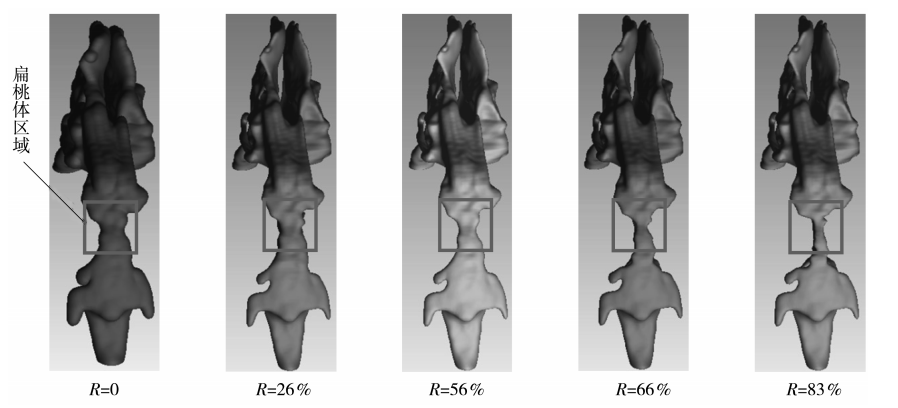
针对目前小儿上气道内流场特性分析较少且实验验证困难等问题,本文基于3D打印技术构建了小儿上气道内流场特性分析的实验平台,实验结果与临床鼻阻力实验的最大误差为11.1%,可为小儿上气道内流场特性的理论分析提供一种直观简便、准确可靠的实验方法。在此基础上,探索了不同程度的扁桃体肥大对内流场特性的影响作用。研究结果表明,当口咽部狭窄度达到56%以上(扁桃体肥大为临床III度),上气道吸气气流将发生急剧变化,流速和流阻增大,通气量下降,内流道出现较大的逆压梯度及内外压差,为患儿夜眠憋气、呼吸暂停、打鼾等症状提供了直观的理论依据,也为临床医生开展扁桃体手术干预和术后恢复方案的制定提供了重要的参考。

本文引用格式

蔡惠坤 , 徐畅 , 薛豪洋 , 郭宇峰 , 高兴强 . 基于3D打印的小儿上气道流场特性研究[J]. 华南理工大学学报(自然科学版), 2022 , 50(6) : 137 -144 . DOI: 10.12141/j.issn.1000-565X.210496

Abstract

Aiming at the problems of limited analysis and difficult validation on flow characteristics of children upper airway, this paper presents an experimental bench using upper airway models manufactured by 3D printing technology to study these problems. The maximum difference between experimental results and clinical nasal resistance test is 11.1%, which proves the experimental method based on 3D printing technology is reliable and accurate, and it can be a direct and easy method for the research of flow characteristics of children upper airway. After that, the effect of different levels of hypertrophy of tonsil on flow characteristics is studied. It is found that, when the narrow level of oropharynx reaches 56%, where the level of hypertrophy of tonsil reaches III degree, flow characteristics of upper airway will obviously change, in terms of increasing flow velocity and resistance, decreasing flow volume, and a large inverse pressure and pressure difference in oropharynx, which can an explanation of the symptoms for OSAHS child, and also will be a significant reference to clinicians on tonsillectomy operation and its postoperative recovery plan.
文章导航

/