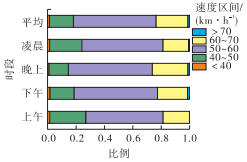
为研究长大下坡路段货车运行特征,提高运行速度预测模型的有效性,确保车辆在长大下坡路段安全行驶,收集西南地区某高速公路连续长大下坡路段断面车速数据,对货车速度时空分布特性及车速离散程度进行分析,并通过Q-Q概率图和单样本K-S检验对长大下坡货车速度分布特征进行检验,得到长大下坡路段货车行驶速度分布特性,根据分布特性进行运行速度模型误差分析,确定误差原因及修正变量,最后建立货车运行速度预测修正模型,并进行模型修正前后有效性对比分析。结果显示:货车在长大下坡路段行驶过程中,随着下坡距离增长,速度先逐渐降低,随后趋于稳定,车速离散程度随着下坡距离及交通量增长而增加;货车车速特性不随时段变化产生明显差异;长大下坡路段断面车速符合Logistic分布的规律,速度高度集中且对称于高峰速度值;现有运行速度预测模型预测货车运行速度时具有误差,速度误差主要原因是模型未考虑交通密度的影响,基于此建立的货车运行速度预测修正模型相对误差降低了4%~14%,有效性明显提升。由此可为长大下坡运行速度研究提供理论基础,提升货车下坡安全性。
The cross-section speed data of a continuous long downhill section of an expressway in Southwest China was collected, in order to study the operating characteristics of trucks on the long downhill section, improve the effectiveness of the operating speed prediction model, and ensure that vehicles can drive safely on the long downhill section. The temporal and spatial distribution characteristics of truck speed and the degree of dispersion of vehicle speed were analyzed, and the speed distribution characteristics of trucks on the long and large downhill road was tested through Q-Q probability diagram and single-sample K-S test, thus the speed distribution characteristics of trucks on the long downhill section were obtained. The error analysis of the operating speed model was carried out according to the distribution characteristics, so as to determine the cause of the error and correct the variable. Finally, a prediction and correction model of truck operating speed was established, and the effectiveness of the mo-del was compared and analyzed before and after the correction. The results show when the truck is traveling on a long downhill section, the speed gradually decreases first and then tends towards stability as the downhill distance increases; the degree of dispersion of vehicle speed increases with the increase of downhill distance and traffic vo-lume. Truck speed characteristics do not change significantly over time; truck speed in the long and large downhill sections conforms to the law of Logistic distribution, and the speed is highly concentrated and symmetrical to the peak speed value. The existing speed prediction model has deviations mainly because these models do not consider the influence of traffic density. The relative error of the truck running speed prediction correction model established based on this is reduced by 4% to 14%, which significantly improved the effectiveness. This can provide a theore-tical basis for the study of the long downhill running speed and improve the downhill safety of trucks.