交通运输工程

基于图卷积循环神经网络的城市轨道客流预测

展开
  • 1.同济大学 道路与交通工程教育部重点实验室,上海 201804; 2.同济大学 CAD研究中心,上海 201804; 3.上海申通地铁集团有限公司,上海 201102
刘晓磊(1997-),女,博士生,主要从事交通大数据研究。E-mail:liuxiaolei_2021@163.com

收稿日期: 2021-05-20

  修回日期: 2021-08-11

  网络出版日期: 2021-08-22

基金资助

上海市科学技术委员会科技计划项目(20dz1202903)

Passenger Flow Forecast of Urban Rail Transit Based on Graph Convolution and Recurrent Neural Network

Expand
  • 1. Key Laboratory of Road Traffic Engineering of the Ministry of Education, Tongji University, Shanghai 201804, China;
    2. CAD Research Center of Tongji University, Shanghai 201804, China;
    3. Shanghai Shentong Metro Group Co., Ltd., Shanghai 201102, China
刘晓磊(1997-),女,博士生,主要从事交通大数据研究。E-mail:liuxiaolei_2021@163.com

Received date: 2021-05-20

  Revised date: 2021-08-11

  Online published: 2021-08-22

Supported by

Supported by Shanghai Science and Technology Commission Research Project (20dz1202903)
摘要

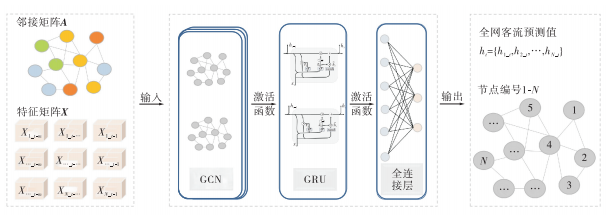
客流预测对于城市轨道交通运行组织和管理具有重要的意义。本文中组合图卷积网络和循环神经网络构建图卷积循环神经网络GCGRU模型,借助图卷积网络学习城市轨道网络的复杂拓扑结构,进而捕捉空间关联特征,通过循环神经网络变体门控循环单元学习多特征客流量的趋势变化规律从而捕捉时间特征。利用上海市1年的全网地铁断面客流量展开研究,并应用随机森林的平均不纯度减少方法进行特征选择,实验结果表明:在大规模城市轨道交通客流预测中,GCGRU能够很好的捕捉城市轨道客流的时空相关性,具有良好的预测效果,预测精度达89%。模型预测结果可为管理者进行轨道交通客流管理与运行组织提供依据,为出行者提供乘车拥挤预警信息,保证城市轨道交通网络的安全高效运营。

本文引用格式

刘晓磊, 段征宇, 余庆, 等 . 基于图卷积循环神经网络的城市轨道客流预测[J]. 华南理工大学学报(自然科学版), 2022 , 50(3) : 21 -27 . DOI: 10.12141/j.issn.1000-565X.210320

Abstract

Passenger flow forecast is of great significance to the organization and management of urban rail transit. This paper constructed a graph convolution and recurrent neural network (GCGRU model) by combining graph convolutional network with recurrent neural network. The graph convolutional network was used to learn the complex topological structure of an urban rail network and capture spatial correlation characteristics. Then one of the recurrent neural network variants called gated recurrent unit was used to learn the variation of multi-characteristics of traffic trends and to capture the temporal characteristics. An experiment was carried out with the passenger flow data obtained from the entire network with all subway cross-sections in Shanghai in a whole year, and the mean decrease impurity method provided by random forest was used for feature selection. The experimental results show that the GCGRU model can well capture the temporal and spatial correlation in the prediction of large-scale urban rail transit passenger flow, with a prediction accuracy of 89%. The prediction results can provide a basis for managers to manage and organize rail transit passenger flow as well as provide travelers with early warning information, ensuring the safe and efficient operation of the urban rail transit network.
文章导航

/