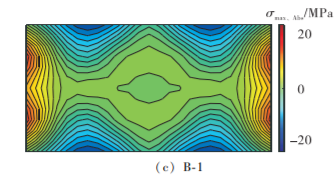
冷弯成型法是一种新的具有良好应用前景的曲面玻璃幕墙建造方法,为研究中空玻璃板冷弯后的力学响应,对中空玻璃板进行单向冷弯试验研究,考虑了不同冷弯曲率、玻璃厚度及空腔厚度对中空玻璃板的主应力分布、主应力变化以及层间相对滑移的影响,在试验的基础上对冷弯中空玻璃板进行了有限元数值模拟。研究结果表明,中空玻璃板冷弯时在各玻璃面上产生的主应力分布不均匀,最大主应力发生于外凸面长边中点,该表面最可能产生破坏应力,间隔条的约束作用使内表面的主应力极值点位置发生偏移;冷弯曲率对玻璃冷弯主应力和层间位移的影响最显著,而空腔厚度以及玻璃厚度的影响较小;所采用的有限元建模方法和材料参数能较好地模拟试验结果,数值稍偏保守。研究成果可为曲面中空玻璃幕墙冷弯成形法的设计和施工提供参考。
Cold bending is a new construction method with good application prospects for curved glass curtain wall. To study the mechanical response of cold-bent insulating glass plates, a single curved cold bending experiment was carried out on the insulating glass plates, and the experiment considered the influence of different cold-bent curvatures, glass thicknesses, and cavity thicknesses on the principal stress and inter-layer displacement. Based on the experiment, the finite element numerical simulation of the cold-bent insulating glass plates was carried out. The results show that the principal stress distribution of each surface of the cold-bent insulating glass is uneven;the maximum cold bending principal stress of the glass plate locates on middle point of long side of the convex surface which is most likely to produce damage stress, and the restraint of the spacer bars can cause the displacement of extreme principal stress point on the inner surfaces;the cold bending curvature has the most significant effect on the cold bending principal stress and interlayer displacement of the insulating glass, while the cavity thickness and the glass thickness have smaller effect. The finite element model method and parameters adopted in this study can well simulate the results of the experiment, even though the results is a little conservative. The research results can provide references for the design and construction of single curved cold bend insulating glass.