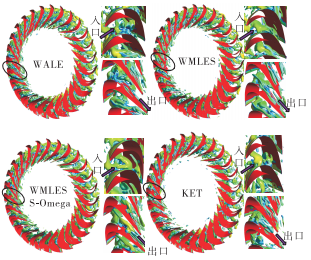
为了准确地揭示液力变矩器流场时空演化机理,基于计算流体动力学理论,采用5种不同的大涡模拟(LES)亚格子湍流模型(SL、WALE、WMLES、WMLES S-Omega、KET)精细仿真制动工况下液力变矩器三维流场,识别并提取涡轮内部非定常多尺度三维涡结构,籍此分析时空多尺度涡演化特征及其对流场结构演变的影响规律。基于粒子图像测速(PIV)技术,采用动态实时标定方法,试验测量液力变矩器涡轮内部流场,依托试验后处理所提取的流速场和涡量场信息,对比验证大涡模拟仿真结果,并对5种亚格子湍流模型的仿真适用性进行分析。结果表明:制动工况下,SL和WMLES模型针对涡轮流道主流区域多尺度涡仿真结果相近,流速为0.32~0.85m/s,涡量为250.77~792.95s-1;针对涡轮叶片压力面近壁高流速区域,WMLES模型仿真结果与PIV试验结果相吻合,流速为3.7~4.4m/s,而WMLES S-Omega模型对该区域内涡量场的仿真结果较好,涡量为526.47s-1;从三维涡仿真角度来看,WMLES和WMLES S-Omega模型对叶片吸力面附近三维涡数值模拟结果更加丰富,针对叶片近壁面小尺度涡旋结构捕捉较为准确,KET模型仿真结果重现了涡轮叶片出口处明显的涡脱落现象,其他模型对于三维涡结构识别不够准确。研究结果可为液力变矩器高精度数值模拟提供理论指导。
In order to accurately reveal the spatio-temporal evolution mechanism of the flow field of the hydraulic torque converter, five different Large Eddy Simulation models (SL, WALE, WMLES, WMLES S-Omega, KET) were used to simulate the three-dimensional flow field of hydraulic torque converter under braking conditions based on computational fluid dynamics theory. It identified and extracted the unsteady multiscale three-dimensional vortex structure inside the turbine, and then analyzed the characteristics of spatiotemporal multiscale vortex evolution and its influence laws on the evolution of flow field structure. Based on Particle Image Velocimetry (PIV) technology, dynamic real-time calibration method was used to measure the flow field inside the turbine of hydraulic torque converter. Based on the velocity and vorticity information extracted from the post processing, the simulation results of large eddy simulation were compared and the simulation applicability of five subgrid-scale turbulence models was analyzed. The results show that under braking conditions, the multiscale eddy simulation results of SL and WMLES models for the main flow area of the turbine channel are similar, the flow velocity ranges from 0.32m/s to 0.85m/s and the vorticity ranges from 250.77s-1 to 792.95s-1; for the turbine blade pressure surface near the wall high velocity area, the simulation results of WMLES model meet the PIV test results, the flow velocity ranges from 3.7m/s to 4.4m/s, while WMLES S-omega model is better for the simulation of vorticity field is better and the vorticity is 526.47s-1. From the perspective of three-dimensional vortex simulation, WMLES and WMLES S-omega models have more abundant numerical simulation results of three-dimensional vortex near the suction surface of blades, and they are more accurate in capturing small-scale vortex structures near the wall of blades. The KET model simulation results reproduce the obvious vortex shedding phenomenon at the turbine blade outlet, while other models are not accurate enough to identify the structure of three-dimensional vortex. The research results can provide theoretical guidance for high precision numerical simulation of hydraulic torque converter.