交通运输工程

引入时空特征的高速公路行程时间预测方法

  • 林培群 ,
  • 夏雨 ,
  • 周楚昊
展开
  • 华南理工大学 土木与交通学院,广东 广州 510640
林培群(1980-),男,博士,教授,主要从事车联网、智能交通等研究。

收稿日期: 2020-11-24

  修回日期: 2021-01-15

  网络出版日期: 2020-12-28

基金资助

国家自然科学基金资助项目(52072130,U1811463);广东省自然科学基金资助项目(2020A1515010349);华南理工大学中央高校基本科研业务费专项资金资助项目(2020ZYGXZR085)

Freeway Travel Time Prediction Based on Spatial and Temporal Characteristics of Road Networks

  • LIN Pei-Qun ,
  • XIA Yu ,
  • ZHOU Chu-Hao
Expand
  • School of Civil Engineering and Transportation, South China University of Technology, Guangzhou 510640, Guangdong, China
林培群(1980-),男,博士,教授,主要从事车联网、智能交通等研究。

Received date: 2020-11-24

  Revised date: 2021-01-15

  Online published: 2020-12-28

Supported by

Supported by the National Natural Science Foundation of China(52072130,U1811463) and the Natural Science Foundation of Guangdong Province(2020A1515010349)
摘要

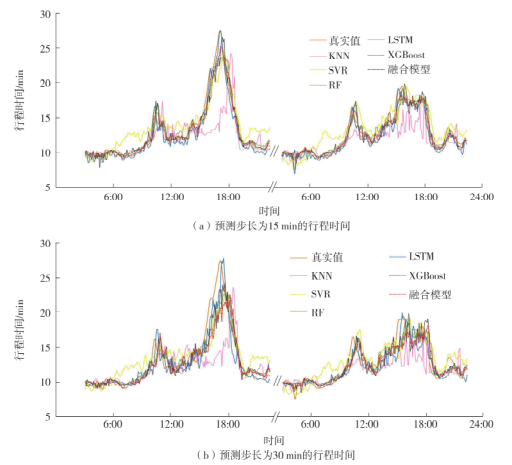
为克服现有方法预测步长短、无法充分利用路网时空特征的局限性,实现高速公路行程时间的准确预测,基于高速公路起讫点(OD)数据集,采用随机森林模型(RF)、极端梯度提升模型(XGBoost)、长短时记忆神经网络模型(LSTM)、K-最近邻模型(KNN)、支持向量机回归模型(SVR)等5种常用算法对车辆行程时间进行多步长预测,并采用贝叶斯回归方法对各算法进行融合,融合模型可综合各预测算法的优点,具有更高的精度和鲁棒性。以广东水官高速龙岗至布龙段为例,对未来2h内每15min的车辆行程时间进行预测,并从预测精度和训练时长等方面对各算法的性能进行了对比分析。结果表明:多种步长下,随机森林算法和XGBoost算法的整体预测效果稳定;在步长较短(未来30min)的预测中,LSTM具有最高的精度;基于贝叶斯回归的融合预测方法综合了各预测算法的优点,整体预测精度最高。

本文引用格式

林培群 , 夏雨 , 周楚昊 . 引入时空特征的高速公路行程时间预测方法[J]. 华南理工大学学报(自然科学版), 2021 , 49(8) : 1 -11 . DOI: 10.12141/j.issn.1000-565X.200717

Abstract

In order to overcome the shortcomings of the existing prediction methods, such as short prediction steps and insufficient utilization of spatial-temporal characteristics of road networks, and to predict the freeway travel time accurately, five commonly used prediction models, namely RF(Random Forests),XGBoost(Extreme Gradient Boosting),LSTM(Long Short-Term Memory),KNN(K-Nearest Neighbor), and SVR(Support Vector Regression), were taken to carry out multi-steps prediction of freeway travel time based on the origin and destination data set. A fusion model based on Bayesian linear regression method was proposed. The Long-gang to Bu-long section of Shui-guan Expressway in Guangdong province was taken as a case study. We predicted the travel time of every 15 minutes in the next 2 hours. The results show that the prediction performance of RF model and XGBoost model is stable under multi-steps; the LSTM model has superior prediction performance in the case of short prediction steps; the fusion method integrates the advantages of various prediction methods and has higher accuracy and robustness. The experiments also demonstrate that it has the best prediction performance.
文章导航

/