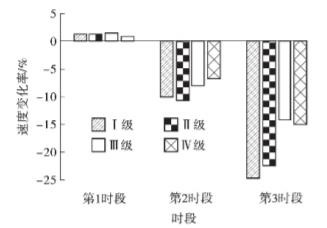
为了研究导航播报措辞复杂度对驾驶行为的影响,以普通交叉口为例,将措辞复杂度分为Ⅰ、Ⅱ、Ⅲ、Ⅳ级,通过驾驶模拟方法获取实验数据,构建考虑驾驶人时空和综合行为表现的多维度指标体系,运用方差分析和非参数检验方法研究不同措辞引导下驾驶人行为表现的时空特征,挖掘驾驶人综合行为表现的变化规律。结果表明: 导航播报情况下驾驶人普遍从交叉口上游 200 m 处开始减速; 4 种措辞的作用效果在交叉口
上游 100 m 至下游 100 m 区段存在明显差异; Ⅰ、Ⅱ级措辞引导下车辆运行的平稳性较差; 与Ⅰ级措辞相比,Ⅱ、Ⅲ和Ⅳ级措辞引导下驾驶人的综合行为表现依次提升 15% 、
20% 和 40% 。
To explore the effects of navigation broadcast wording complexity on driving behaviors, this paper took ordinary intersections as an example, divided wording complexity into levels: I, II, III and IV , obtained experiment data through driving simulation method, constructed a multi-dimensional indicator system considering the spatiotemporal and comprehensive driving performance of drivers, and explored the temporal and spatial characteristics of driver behaviors under different navigation broadcast wordings using variance analysis and nonparametric test methods, excavated the change rule of comprehensive driving performance. The results showed that drivers start to slow down from 200m upstream of the intersection; the effects of the four broadcast wordings are obviously different beteween100m upstream to 100m downstream in the intersection; under the guidance of Level I and II broadcast wording, the stability of vehicle operation is poor; compared with Level I wording, the comprehensive behavior of the driver under the guidance of Level II, III and IV broadcast wording improves by 15%, 20% and 40% respectively.