能源、动力与电气工程

基于深度学习的办公建筑照明插座能耗多步预测

展开
  • 华南理工大学 机械与汽车工程学院,广东 广州 510640
周璇(1976-),女,博士,副研究员,主要从事空调节能、数据挖掘等的研究。E-mail: zhouxuan@scut. edu. cn

收稿日期: 2019-08-29

  修回日期: 2020-04-24

  网络出版日期: 2020-09-14

基金资助

广东省自然科学基金资助项目 ( 2017A030310162,2018A030313352 ); 广东省科技计划项目(2017A020216023)

Multi-Step Forecasting for Lighting and Equipment Energy Consumption in Office Building Based on Deep Learning

Expand
  • School of Mechanical and Automotive Engineering,South China University of Technology,Guangzhou 510640,Guangdong,China
周璇(1976-),女,博士,副研究员,主要从事空调节能、数据挖掘等的研究。E-mail: zhouxuan@scut. edu. cn

Received date: 2019-08-29

  Revised date: 2020-04-24

  Online published: 2020-09-14

Supported by

Supported by the Natural Science Foundation of Guangdong Province (2017A030310162,2018A030313352)and the Science and Technology Planning Project of Guangdong Province (2017A020216023 )
摘要

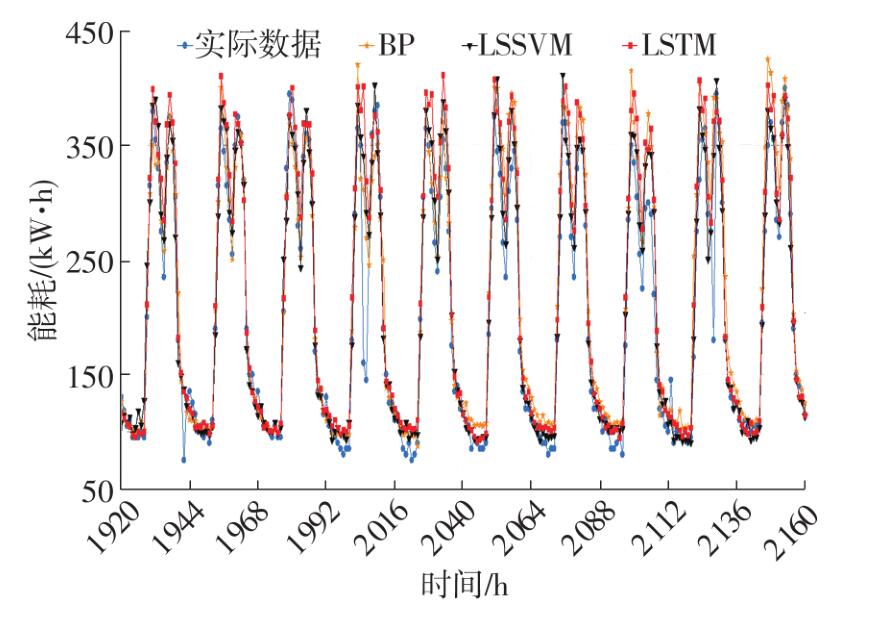
照明插座能耗多步预测对建筑电力负荷调度、能耗优化管理等节能技术的研究具有重要意义。然而,由于受到人行为、室外干球温度、相对湿度等诸多因素的影响,照明插座能耗时间序列具有不确定性、随机性以及非线性等特征,难以准确预测。文中分析了大型办公建筑照明插座分项能耗时间序列的分布特征,采用长短期记忆模型,提出了基于深度学习的多步预测建模方法,讨论了隐含层数、隐含层神经元数与迭代次数等深度学习建模超参数的选择问题,并探讨了样本数量对模型预测精度的影响。仿真结果表明,与 BP 神经网络模型、最小二乘支持向量机模型相比,深度学习预测模型的 24h多步预测平均精度分别提高了 13. 25%与 4. 23%。

本文引用格式

周璇, 雷尚鹏, 闫军威 . 基于深度学习的办公建筑照明插座能耗多步预测[J]. 华南理工大学学报(自然科学版), 2020 , 48(10) : 19 -29 . DOI: 10.12141/j.issn.1000-565X.190546

Abstract

Multi-step forecasting for lighting and equipment energy consumption is important for fine management of building energy,regulation of power load and other areas related to building energy saving. However,due to the uncertainty,randomness and nonlinearity caused by multiple factors,such as indoor human behavior,external en-vironment and relative humidity,it is difficult to make accurate prediction of lighting and equipment energy con-sumption. In this paper,the distribution tendency of time series of sub-item energy consumption in large-scale of-fice building was analyzed,and a multi-step forecasting method for lighting and equipment energy consumption was put forward based on long-short term model. Moreover,parameter selection issues concerning the deep learning model,such as the number of hidden layer,the number of hidden layer neurons and the times of iterations depth were discussed,and the influence of sample size on the model accuracy was investigated. Simulation results show that the average accuracy of the 24h multi-step forecasting model based on deep learning is improved by 13. 25% and 4. 23% respectively compared with that of the BP neural network and least squares support vector machine.
文章导航

/

