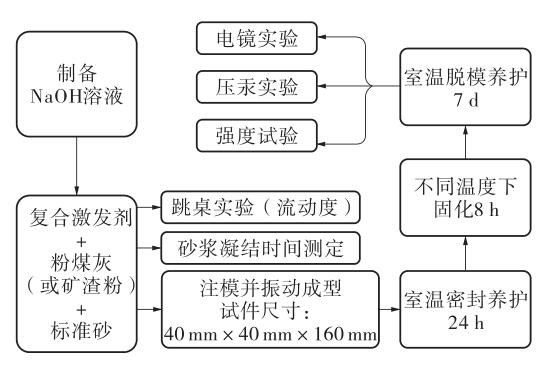
为探讨矿渣粉改性粉煤灰地聚物砂浆在不同温度下的强度变化规律及改善机 理,进行了不同矿渣粉掺量的粉煤灰地聚物在多种温度下的力学性能试验,并分析了其 微观形貌及孔结构特征。结果表明:粉煤灰基地聚物在室温固化时的抗压强度和抗弯强 度均较小,掺入矿渣粉或高温固化都可以改善粉煤灰地聚物的力学性能,但高温固化导 致后期抗压强度变化变缓;当不掺矿渣粉时,地聚物砂浆的流动度为232mm,但凝结 时间超过8h;随着矿渣粉掺量的增加,地聚物的流动度逐渐降低,凝结时间也变短; 高温固化和掺入矿渣粉都可以显著减小粉煤灰地聚物材料的孔隙率;室温固化时,地聚 物砂浆中含有大量宏观孔隙,并且粉煤灰地聚物砂浆中基本不存在胶凝孔隙;高温固化 后,粉煤灰地聚物砂浆中以毛细孔隙体积占比最大,而改性砂浆则以胶凝孔隙和过渡孔 隙的居多;从试件内部的微观形貌图可见,掺入矿渣粉后地聚物砂浆变得更加致密;基 于热力学关系的分形模型可以在压汞法测量的孔径范围内很好地描述地聚物砂浆孔结构 的分形维数,其次为孔轴线模型;地聚物砂浆孔结构的分形维数大于2.0,在粉煤灰地 聚物中掺入矿渣粉可以改善地聚物的孔隙结构,提升固化温度则使得地聚物的孔隙结构 变得复杂。
In order to investigate the strength development rules and the improvement mechanism of granulated
blast-furnace slag (BFS) modified fly ash based geopolymer mortar at different temperatures, the mechanical properties of fly ash based geopolymer with different BFS content at various temperatures were measured, and the microscopic morphology and microscopic pore structure characteristics were analyzed. The results show that the compressive strength and flexural strength of fly ash based geopolymer are small when curing at room temperature, and
the mechanical properties of fly ash based geopolymer can be improved by mixing BFS or elevating curing temperature. However, high temperature curing probably lead to a slow development of later compressive strength. When
not mixed with BFS, the flow degree of the geopolymer is 232mm, and the condensation time exceeds 8 h. With
the increase of BFS content, the flow degree and condensation time of the geopolymer decrease gradually. Both
elevating curing temperature and mixing BFS can significantly reduce the porosity of fly ash based geopolymer. When
just cured at room temperature, the geopolymer mortar contains a large amount of macroscopic pores, and there is
substantially no gelling pores. Through high temperature curing, the proportion of capillary pores becomes the largest
in the fly ash based geopolymer mortar, and the modified geopolymer is mostly composed of gel pores and transition
pores. It can be seen from the microtopography of the specimens that geopolymer becomes more dense after mixed
with the BFS; the fractal model based on thermodynamic relation can perfectly describe the pore structure profile of
the geopolymer within the measurement range of mercury intrusion porosimetry, followed by the pore axis model; the
fractal dimension of pore structure of the specimens is greater than 2. 0. Adding BFS to the fly ash based geopolymer can
improve the pore structure, while lifting curing temperature makes the pore structure of the geopolymer complex.