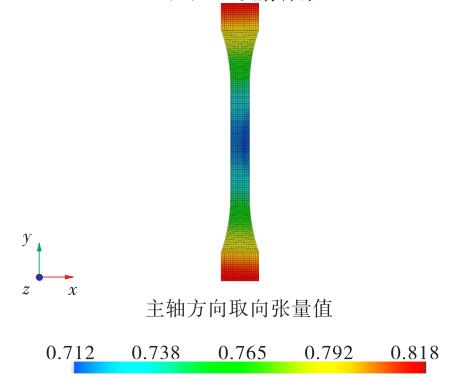
本研究采用一款增韧剂及玻璃纤维(GF)改性的聚对苯二甲酸乙二醇酯 (PET)材料进行车身结构设计研究,结合该材料的高冲击韧性、高比强度、高比刚度 等特点,针对注塑工艺特点对非承载式车身采用了分块式设计方案并通过结构胶连接为 车身主体,以最大程度地降低车身重量,实现整车轻量化。实验表明,15%短玻纤增强 PET 因玻纤取向导致的注塑样条的模量及强度差异可达到40%~50% ,以致很难获取 较为准确的仿真结果用于指导设计。本研究通过对所应用的玻纤增强PET复合材料进 行微观及基础力学性能分析,通过 Moldflow、Digimat、Abaqus 等工程软件建立较高精 度的样条级仿真,校正材料参数,将校正结果用于整体注塑车身的刚度及模态仿真并与 试验结果进行对比,获取了较精准的仿真结果,准静态仿真精度提升至85%以上
A toughener and glass fiber (GF) modified polyethylene terephthalate (PET) material was used to study
the vehicle body design. Considering the material’s high impact toughness, high specific strength, high specific
stiffness and the characteristics of the injection molding process, the non-loaded body adopts a block design and is
connected to the body by structural glue, which can minimize the weight of the vehicle body and realizes the weight
reduction of the whole vehicle. The experiment shows that the modulus and strength difference of the 15% short glass
fiber reinforced PET can reach 40% ~50% because of glass fiber orientation, thus makes it difficult to obtain accurate simulation results for guiding the design. In this research, the microscopic and basic mechanical properties of
the glass fiber reinforced PET composites were studied. The high precision spline simulation was established with engineering software such as Moldflow, Digimat and Abaqus. The material parameters were corrected and the results were
used for stiffness and modal simulation of the whole injection molded vehicle. The simulation results were compared with
the test results, and the quasi-static simulation accuracy of the injection molded product was improved to over 85%.