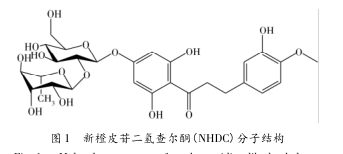
类黄酮与金属配位后往往能改善其生物活性.通过摩尔比法,等摩尔溶液连续配位法研究了新橙皮苷二氢查尔酮(NHDC)铜配合物的配位比.以紫外、红外和X-射线衍射研究了NHDC配位前后的结构变化.以DPPH法、水杨酸法和FRAP法比较NHDC配位前后抗氧化活性变化.结果表明:NHDC与铜的配位比为2:1,NHDC-Cu(Ⅱ)配合物稳定性受pH影响大,在pH 7.0最稳定;NHDC与铜配位后对羟基自由基清除能力明显增强,原因可能和配位改善了NHDC的水溶性、增加NHDC的非晶化程度有关;而NHDC配位后的水溶性和生物利用度增加,归因于NHDC配位后铜对NHDC的非糖配基的“集中效应”和糖部分对非糖部分的“包埋效应”. 但配体及配合物对脂溶性自由基如DPPH·清除能力及总还原力无明显变化.
Flavonoids often improve their biological activity after having coordinated with metal ions. In this paper, the coordination ratio of the complex of neohesperidin dihydrochalcone(NHDC) with copper(II) was studied by the method of molar ratio and continuous coordination in equal molar solution. Before and after the coordination, the complex structure was studied by UV, IR and X-ray diffraction. DPPH method, salicylic acid method and FRAP method were used to compare the variation of antioxidant activity. Results indicated that the coordination ratio of NHDC to copper was 2: 1, the stability of the NHDC-Cu (Ⅱ) complex was greatly affected by pH and the most stable state was at pH 7.0. The hydroxyl radical-scavenging activity was significantly enhanced possibly due to the improvement of water solubility and the increase of the amorphous degree after coordination with copper. And the increase of water solubility and bioavailability after NHDC coordination was attributed to the "concentrated effect" of copper on NHDC non-sugar ligand and the "embedding effect" of sugar part on the non-sugar part after NHDC coordination. However, there was no significant changes for scavenging fat-soluble free radicals like DPPH· and total reduction force by NHDC or its complex with Cu2+.